
Optimisation of pre-treatment tunnels
A pre-treatment tunnel that no longer performs as it should is a problem we at Coateq frequently encounter with customers. Recently, we have overhauled existing tunnels at three different customers. Each time, the tunnels came from other manufacturers, and each came with its own challenges. Below is an overview of what we tackled, without naming any customers but with enough detail to show what is possible.
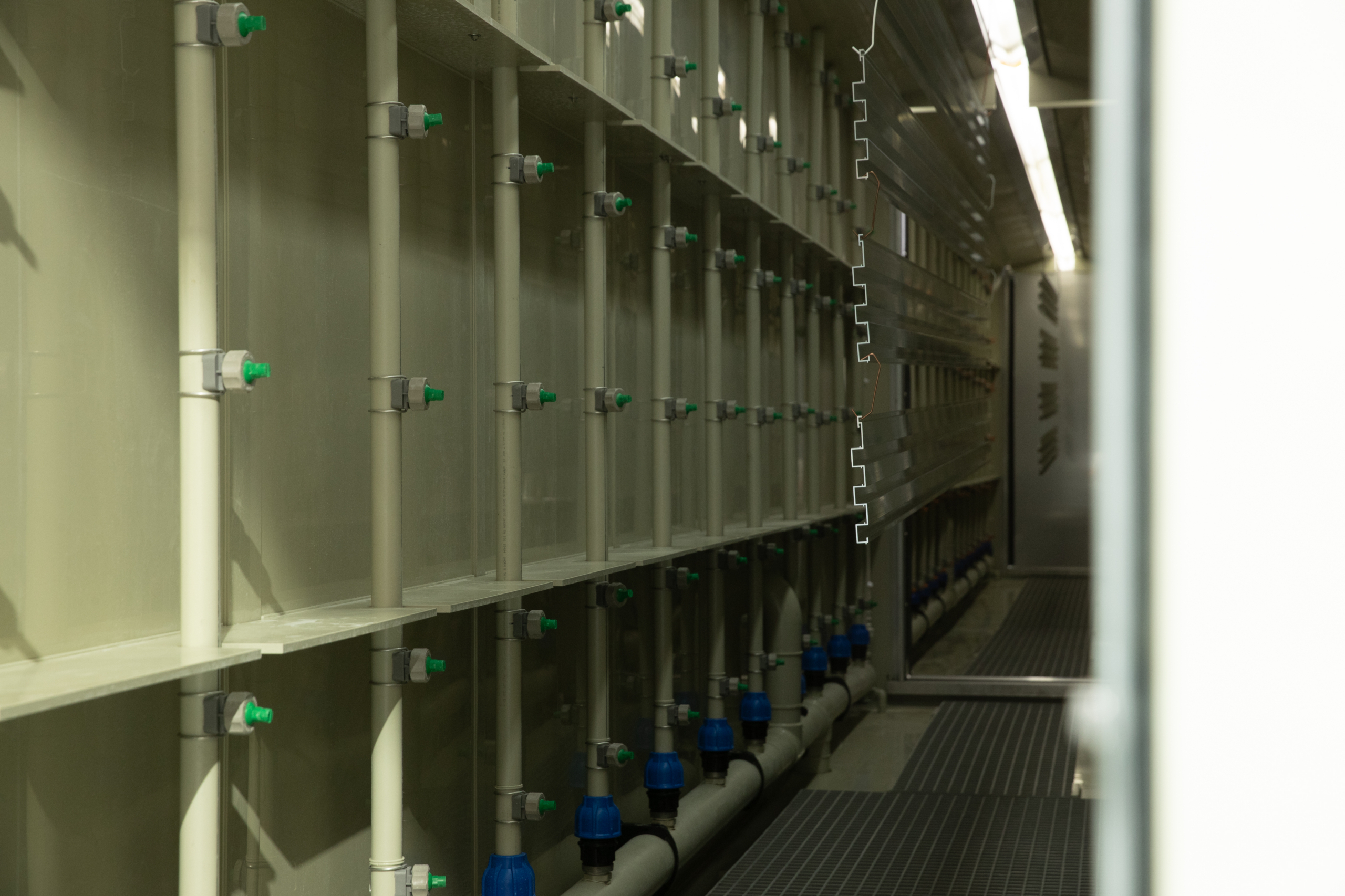
Case 1: continuous tunnel in Northern France
At this customer, the tunnel was no longer working properly: the values were off, and monitoring was not always carried out by someone with sufficient technical knowledge of the process. It is a familiar problem, as not every organisation has someone in-house who can monitor a tunnel perfectly.
The result: an installation that operates fully autonomously, with consistently correct pH, chemical activity and rinse values. What’s more, the system was added completely independently of the existing installation, without us needing access to the original control system. This is a clear advantage with older or closed systems.
While we were on site, we also inspected and readjusted the ion exchanger and the demineralised water installation, resetting the correct percentages for recirculation/reuse and the production of fresh water. The cascade effect and level control were also fine-tuned.
Finally, separate from the tunnel itself, we carried out air velocity measurements on all powder coating booths, giving the customer renewed assurance that they are operating in compliance with regulations.
What we did:
Automatic dosing
Degreasing and conversion agents are now dosed automatically.
Conductivity measurement
Added to the final rinse bath before conversion and to the conversion bath itself.
Cascade control
Automated cascade between baths, with automatic top-up of mains and/or demineralised water.
Case 2: continuous tunnel in East Flanders
At this customer, the problems were smaller in scale, but no less relevant:
- The dosing system was drawing in air, which meant top-up dosing no longer worked correctly. The system was completely readjusted.
- The strainers in the bath were not robust enough, causing them to buckle and come loose from their seating. Solution: custom-made, reinforced strainers.
- Several pipes were leaking. These were replaced with PP instead of PVC, which is more chemically resistant and more flexible in use.
- The programming of the spray pumps and butterfly valves was revised so that the right channels close at the right moment. This prevents a pressure surge in the pipes when the butterfly valve opens while the pump is already under pressure.

Case 3: multi-stage tunnel in West Flanders
At this third customer, we worked on a multi-stage tunnel where we analysed several leaks and either resolved or prevented them. In addition:
- The part detection in the tunnel was correctly readjusted so that spray pumps no longer ran unnecessarily in sections of the tunnel where no parts were present. The result: a significant energy saving.
- The cycle timing of the tunnel was reset to reduce drag-out, keeping the rinse baths cleaner and the conductivity lower. The result: better rinsing and cleaner parts at the end of the line.
- Misting rings and spray pipes were cleaned and readjusted, so that a minimum amount of fresh water was needed and less water ran out of the line.
Together, these interventions brought about a clear improvement, restoring the tunnel to the level it was originally designed for.

When a pre-treatment tunnel is no longer fully under control, Coateq is the partner to call. Together with the chemical supplier where needed, we analyse the problem and handle the solution from A to Z: from automation to on-site execution, from small tweaks to major modifications.
And we go beyond the tunnel, with the same approach for ovens, powder coating booths and spark detection systems.
